South Wales Valleys
Single-storey rear extensions in the South Wales Valleys
Ground-floor space across the back of the house, usually for a kitchen, dining or family room. Across the South Wales Valleys we handle the whole rear extension: survey, drawings, the planning route, building control and the build. Towns we cover here include Rhondda, Tonypandy and Bridgend.
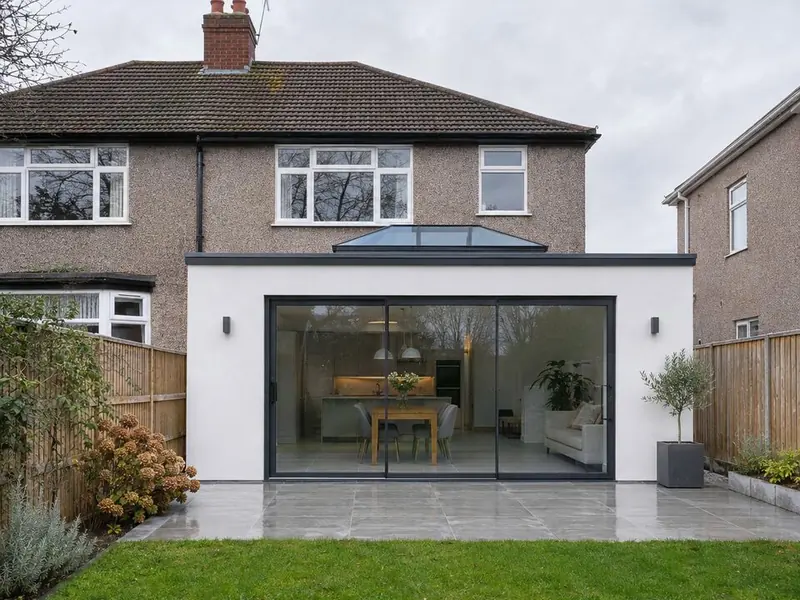
A single-storey rear extension in Rhondda is mostly built from the garden side, so the house stays usable for most of the job. Stone terraces along the valley floors and post-war semis higher up are typical of the South Wales Valleys. Sloping sites are common, so floor levels and retaining walls are designed at the start.
How much does a single-storey rear extension cost in the South Wales Valleys?
Guide prices for a single-storey rear extension in the South Wales Valleys start from our Wales rate of £1,770–£2,880 per square metre, including VAT. Prices in Wales sit below our West Midlands baseline; sloping sites are the main variable.
| Size | Guide price inc VAT |
|---|---|
| 3 m wide × 4 m deep (12 m²) | £21,000–£34,500 |
| 4 m wide × 5 m deep (20 m²) | £35,500–£57,500 |
| 4 m wide × 6 m deep (24 m²) | £42,500–£69,000 |
These are guide ranges; the written quote after the survey is the figure that counts.
Do you need planning permission in the South Wales Valleys?
The Welsh Government's householder rules let many homes add a single-storey rear extension up to 4 metres deep and 4 metres high without a planning application. Deeper projects go through a householder application, because Wales has no prior approval route.
Conservation areas, National Parks and National Landscapes restrict permitted development in Wales, and listed buildings need listed building consent.
Where in the South Wales Valleys do we work?
FAQ
Questions people ask
Is a flat roof or a pitched roof better?
A warm flat roof keeps the extension low under first-floor windows and suits a roof lantern; a pitched or lean-to roof gives a vaulted ceiling. Both last for decades when built properly.
Can I stay in the house during the build?
Usually yes. The noisiest, dustiest stage, removing the back wall, is kept to the final weeks and screened off. Most families set up a temporary kitchen elsewhere in the house.
Will the extension make the room behind it dark?
Not if it is designed well. Rooflights or a lantern over the old back room, and a wide opening into it, keep daylight reaching the middle of the house.
Do you cover all of the South Wales Valleys?
We cover 27 towns and districts in the South Wales Valleys, including Rhondda, Tonypandy and Bridgend.
Who builds the extension?
Vetted building teams working under contract to us; your contract is with S&K Property Investments and Improvement Ltd.